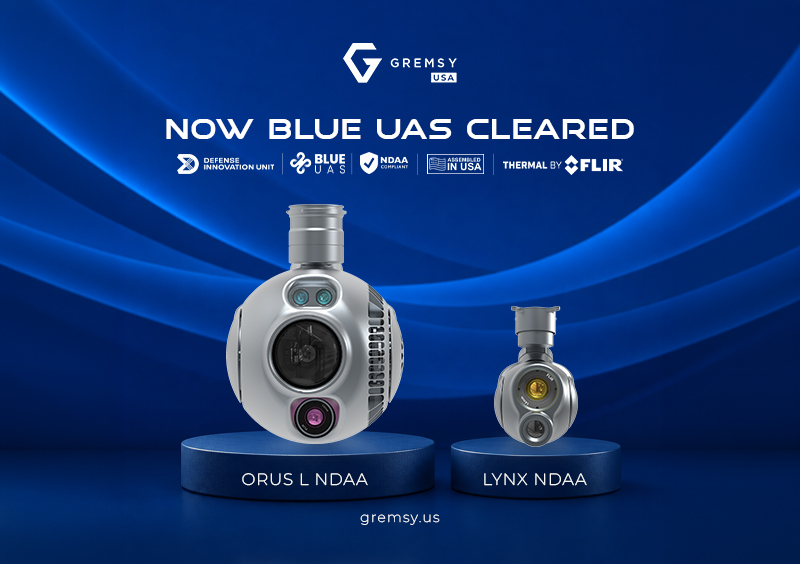
Gremsy’s latest innovation, the ORUS L, is set to redefine what’s possible for industrial and tactical UAV missions. As a highly capable gimbal payload, it’s designed to bring powerful AI to the edge, enabling smarter, more autonomous operations. To address the diverse and often specific needs of its clientele, particularly those operating under strict regulatory frameworks, Gremsy has strategically launched two versions of the ORUS L: a standard model and an NDAA-compliant model.
While both versions appear nearly identical and share a robust set of core features, a closer look at their specifications reveals key differences that cater to their intended markets. The primary distinctions are found in the IR thermal camera and subtle variations in hardware that impact overall weight and performance.
Key Specifications
| ORUS L Standard | ORUS L NDAA | |
| Payload Weight | ~1504g (with Damping) | ~1493g (with Damping) |
| IR Sensor Model | COIN612 | FLIR Boson 640R |
| IR Frame Rate | 30Hz | 60Hz |
| IR Lens | Fixed, Athermal, 19mm | Fixed, 14mm, 32° HFOV |
| Video Output (IR) | 640×512 @ 30Hz | 640×512 @ 60Hz |
| IR Formats | JPEG / TIFF / MP4 | JPEG / TIFF / CSV / MP4 |
Key Technical Differences
The primary distinction lies in the IR camera hardware and performance. Here’s a breakdown:
IR Sensor Model:
- Standard ORUS L: Uses a COIN612 sensor.
- NDAA ORUS L: Uses a FLIR Boson 640R sensor, which is required for compliance.
IR Frame Rate:
- Standard ORUS L: Operates at 30Hz (30 frames per second). This rate is suitable for general monitoring tasks.
- NDAA ORUS L: Operates at 60Hz (60 frames per second), double the speed of the standard version.
Why These Differences Matter
The distinction between 30Hz and 60Hz has a significant impact on performance, especially in demanding missions:
- Smoother Video: The 60Hz frame rate of the NDAA model produces a much smoother video feed. This is critical for missions involving high-speed flight or fast-moving targets, as it helps reduce motion blur.
- Faster Decision-Making: With more data captured per second, operators can make quicker and more accurate decisions during critical operations like search and rescue or border patrol.
- Enhanced Analysis: The higher frame rate allows for a more detailed analysis of fast-moving thermal events, providing greater situational awareness.
Other Notable Specifications
Beyond the frame rate, other differences between the two models affect their utility and performance:
- Payload Weight: The NDAA version is consistently lighter than the standard model. Specifically, it weighs approximately 1493g (with Damping) compared to the standard’s 1504g, and 1377g (QR only) versus the standard’s 1388g. This subtle difference can be a crucial factor for endurance-focused UAVs where every gram counts.
- IR Lens and Field of View (FOV): The NDAA model features a 14mm lens with a wider 32° HFOV. This allows it to capture a larger area in a single frame, which is advantageous for broad area surveillance. In contrast, the standard model’s 19mm lens provides a narrower view, suitable for inspecting specific, smaller targets.
- IR Video Output and Formats: The NDAA version’s ability to output video at 60Hz is a direct result of its superior sensor. Additionally, the file formats are different:
- Standard ORUS L: Supports image format as JPEG/TIFF and video as MP4.
- NDAA ORUS L: Supports image formats as JPEG/TIFF/CSV and video as MP4. This provides greater flexibility for specialized analysis and post-processing tasks.
This dual-version approach allows Gremsy to provide a tailored solution that addresses both technical performance needs and regulatory requirements.
Intended Use Cases
ORUS L (Standard): This version is designed for the broader commercial market and applications where NDAA compliance is not a core requirement. With its robust features, it is an ideal choice for:
- Industrial Inspections: Checking power lines, pipelines, and transportation infrastructure.
- General Security: Surveillance for industrial zones, public events, or critical facilities.
ORUS L (NDAA-Compliant): Engineered to meet the stringent requirements of specific regulatory environments, this version is purpose-built for high-stakes missions where compliance and precision are paramount. Its applications include:
- High-Stakes Operational Awareness: Providing real-time, high-precision data for tactical operations that demand heightened situational awareness and rapid response capabilities.
- Secured Deployment Environments: Deployments that require U.S. regulatory adherence and the use of approved, high-performance components for mission integrity.
- Critical Infrastructure and Border Protection: Monitoring and securing vital infrastructure and sensitive areas in demanding operational settings.
Where to Buy
The ORUS L is now available for order and purchase on the official Gremsy website.
- Learn more and buy now: ORUS L – Gremsy
- Watch the official launch video: The Wait Is Over: ORUS L IS OFFICIALLY LAUNCHED